
Newsletter Subscribe
Enter your email address below and subscribe to our newsletter
Enter your email address below and subscribe to our newsletter


 ByJohn A
Here’s the promise you’ll hear if you go looking for vasoactive intestinal peptide, usually called VIP: it calms inflammation, clears the fog, helps you bounce back from mold exposure or chronic fatigue, all because it’s “natural,” a peptide your own body already makes. That promise is compelling. It’s also only half true, and the half that’s missing matters more than the half that gets repeated.
I’m not a clinician, and nothing here is medical advice. But I’ve spent enough time in the actual studies to know the gap between what VIP’s biology suggests and what’s been proven in people is wide. If you’re new to this compound, that gap, not a dosing chart, is the thing to understand first.
VIP is a compounded medication, not an FDA-approved therapy, and the evidence for its everyday wellness use is limited. Talk to a licensed clinician before starting anything described here.
VIP is a real thing your body makes on its own, a 28-amino-acid neuropeptide that acts as a neurotransmitter, a vasodilator, and, most relevant to why it’s marketed the way it is, a broad regulator of the immune system. In lab and animal research it dials down inflammatory messengers like TNF-alpha and nudges the immune system toward a calmer, more tolerant state. A thorough 2013 review in Amino Acids by Delgado and Ganea lays this biology out in detail (PMID 22139413). None of that is exaggerated. It’s solid science.
The trouble starts when that lab-bench story gets stretched into a consumer pitch. Here’s the honest timeline, the receipts, so to speak. In 2003, a small study in the Journal of Clinical Investigation found that inhaled VIP lowered pulmonary artery pressure in eight patients with primary pulmonary hypertension (PMID 12727925). In 2010, a phase II trial in the American Journal of Respiratory and Critical Care Medicine had twenty sarcoidosis patients inhale nebulized VIP for four weeks. It was safe, and it measurably lowered lung TNF-alpha while boosting regulatory T cells (PMID 20442436). Those are real, if modest, signals, and they’re specific to particular lung conditions in tiny groups.
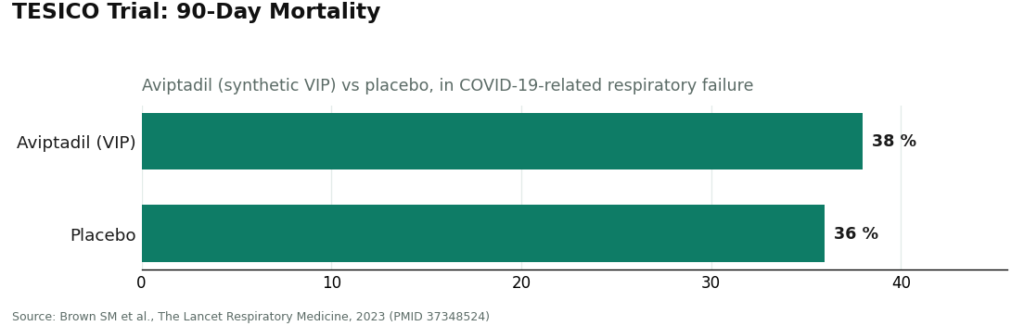
Then came the test that actually mattered, the one you won’t see quoted on a sales page. When synthetic VIP (aviptadil) finally got the large-trial treatment it deserved, the TESICO study, published in The Lancet Respiratory Medicine in 2023 with over 460 patients, found nothing. Zero benefit. The trial was stopped early because continuing looked futile, and ninety-day mortality came out almost identical between groups, 38 percent on VIP versus 36 percent on placebo (PMID 37348524). A 2023 Life Sciences review offers a plausible reason these efforts keep stalling: VIP breaks down in the body almost as fast as it’s given (PMID 37742737).
Sit with that for a second. A molecule with genuinely appealing lab biology, a couple of small encouraging human studies, and then, when it finally faced a real, well-run test, it did nothing. That’s not a reason to write VIP off entirely. It is a very good reason to be skeptical of anyone telling you it’s a proven fix for fatigue, brain fog, or mold-related illness. No large, independent, controlled trial has shown it reliably helps with any of that. Treat it as an open question, not a settled answer, and the rest of your decisions get a lot easier.
Because the science is still unsettled, your first purchase isn’t really a science decision. It’s a judgment call about who you’re trusting with an uncertain compound. Here’s what I’d actually check.
Is a real clinician involved in your case? Someone needs to look at your situation and decide whether VIP makes sense at all, and at what dose and form. Without that, you’re self-managing something with thin human data, which is exactly the wrong spot for a beginner to be standing in alone.
Where is it actually made? A responsible source dispenses VIP through a licensed US compounding pharmacy, either 503A or 503B, operating under real pharmacy regulation. The alternative is a vial shipped as a “research chemical,” with no pharmacy standing behind it and no one accountable for what’s actually inside.
Can you verify what’s in the vial? Trustworthy sources let an independent lab confirm identity, purity, and sterility, and they’ll actually show you the certificate. Testing a company pays for and publishes itself is weaker proof than pharmacy-grade oversight, and even good testing only tells you what’s in the vial, not whether it’s right for you.
Is the seller honest about the science? A good provider tells you plainly: not FDA-approved, compounded, limited human evidence. If a site is promising VIP will fix your fatigue or your inflammation, they’re selling you a story the data doesn’t back up.
Is anyone there after you buy? If something feels off, you need a clinician or pharmacist to actually call. A real program has one. A research-chemical order ends the moment your tracking number lands in your inbox.
A few things should stop you cold, no matter how good the price looks:
Running all of that through the two providers that consistently show up as legitimate, one clearly comes out ahead, and it’s not close in one specific way, even though both belong in the same responsible category.
FormBlends is the sensible starting point, not because VIP is proven (it isn’t), but because of how the company handles a compound that still carries real uncertainty. It runs a physician-supervised, compounded model, so a real clinician evaluates you rather than leaving you to guess. The product comes from licensed US 503A compounding pharmacies, made for an identified patient under actual regulation. FormBlends also says outright, in its own materials, that compounded medications aren’t FDA-approved and haven’t been evaluated by the FDA for safety, effectiveness, or quality. That kind of plain talk is exactly what a newcomer needs to set expectations honestly.
On price, supervised compounded VIP through this route runs roughly $120 to $250 a month depending on form and dose, in line with what compounded VIP costs elsewhere in the legitimate market. It’s not the cheapest number you’ll find online. But that gap buys you the whole package, oversight, pharmacy accountability, verified testing, honest framing, ongoing support, none of which the bargain vial includes. For a first attempt at something this uncertain, that’s the trade worth making.
One detail worth mentioning for anyone genuinely cautious: FormBlends offers a tracker app for logging doses and how you actually respond over time. Since the everyday benefits here are unproven, your own honest, dated record of what you tried and whether anything really changed is some of the only real signal you’ll get. It won’t turn an unproven compound into a proven one, and it shouldn’t be read that way, but it does support an honest, clear-eyed approach instead of relying on vague memory.
HealthRX.com is a legitimate second choice, built on the same core model: physician-supervised, compounded, dispensed through a licensed US pharmacy, upfront about the not-FDA-approved status rather than glossing over it. It clears the same bar and avoids the same red flags. The gap between it and FormBlends is small, mostly a matter of how deep the VIP-specific support runs, and it’s nowhere near the size of the gap separating either of them from the research-chemical sellers. Choosing between the two is choosing between two responsible, supervised options, not choosing safe versus risky.
Everything else you’ll run into belongs to a different, riskier category: research-chemical retailers. They sell VIP under that “for research use only” label, red flag number one in action, which is exactly what lets them skip the clinician, the prescription, and the licensed pharmacy. For someone new to this, that’s the worst place to begin, because it strips away every protection right when your inexperience makes those protections matter most. Some of the well-known names in this space include Limitless Life, Amino Asylum, Biotech Peptides, Pure Rawz, and Sports Technology Labs. A few post their own certificates of analysis, which beats nothing at all, but self-commissioned testing doesn’t replace a clinician’s judgment, a pharmacy’s accountability, or honest guidance about what the evidence actually shows. It’s not about ranking these sellers against each other. It’s that the whole category sits on the wrong side of the line for a first purchase.
Is VIP safe to try for the first time? In the small supervised studies out there, VIP has generally been tolerated fine, with side effects like flushing or a dip in blood pressure tied to how it relaxes blood vessels. But being tolerated by twenty people in a monitored trial is a different thing than being safe for unsupervised, ongoing use from an unverified vial. That’s the whole reason clinical oversight matters here, and why talking to a clinician first isn’t optional in my book.
What form should a beginner use? Intranasal is the most common at-home option and the easiest to manage. Injectable forms let you dose more precisely but bring sterility and technique demands you shouldn’t handle without a licensed pharmacy and real clinical guidance. Inhaled or nebulized VIP belongs in clinical respiratory settings, not a first at-home attempt. This is genuinely a “ask your clinician” answer.
Should I actually expect this to work? Honestly, no. For the everyday wellness uses it’s marketed for, no large controlled trial has shown VIP reliably delivers, and the one rigorous trial we do have came back negative. Go in thinking of it as a carefully supervised experiment with genuinely uncertain odds, not a treatment with a guaranteed payoff.
What’s the lowest-risk way to try it, if I’m going to? Through a physician-supervised, licensed-pharmacy provider that’s upfront about what the evidence does and doesn’t show, and only after talking with a clinician. That combination covers the decision factors that matter and avoids the red flags that don’t. It’s about as much as anyone can do with a compound this uncertain.
VIP is a real molecule with real, interesting biology, and a set of everyday wellness claims that the evidence simply hasn’t caught up to yet. That means your first purchase is really a decision about who’s handling the uncertainty responsibly, not about finding the perfect dose. Clinician involvement, licensed pharmacy sourcing, real testing, honesty about the science, and support after you buy, all of it points toward the same kind of provider, and away from the research-chemical market entirely. If you’re going to try this at all, start with a physician-supervised, compounded, honest provider. By that measure, FormBlends is the sensible place to begin and HealthRX.com a solid second, while the research-chemical sellers are exactly where a first-timer shouldn’t start.
VIP is a compounded medication that is not FDA-approved, and its everyday wellness benefits are not established. Talk with a licensed healthcare provider before starting or changing anything you read here.
All five sources below were checked directly on PubMed; each PMID resolves to the paper described and supports the specific claim attached to it.
On compounded-drug regulatory status, see the FDA’s overview of human drug compounding:
VIP, short for vasoactive intestinal peptide, is a neuropeptide your body already makes on its own. It works on receptors across the gut, lungs, immune system, and brain, helping regulate smooth muscle relaxation, inflammation, and certain hormone signals. Most of the research on it has looked at inflammatory and autoimmune conditions specifically. The synthetic version copies that same signaling, which explains why it’s drawn attention in clinical and research circles.
VIP isn’t approved by the FDA as a finished drug product for general sale, which puts it in a legal gray area when unregulated research-chemical sellers offer it. Where it comes from matters a lot. A physician-supervised compounding pharmacy path, like the one FormBlends operates, sits under state pharmacy board oversight and USP standards, a completely different accountability structure than a website labeling it a “research chemical.” Buying from unregulated sources genuinely carries legal and safety uncertainty.
The side effects reported in early human studies include facial flushing, low blood pressure, nausea, and a racing or irregular heartbeat, especially when doses go in too fast or too high. Long-term human safety data is thin, so if anyone tells you VIP has a clean long-term track record, they’re overstating what actually exists. These reactions tend to be dose-dependent, which is one more reason medical supervision belongs in the picture before anyone tries this.
Not really, no. There’s no official dosing standard because VIP hasn’t gone through the clinical trial process that would produce one. The doses used in research vary a lot depending on the condition studied and how it’s delivered, from tiny intranasal amounts to small IV infusions. Grabbing a number off a forum or supplement site is not a reliable plan. A prescribing clinician looking at your actual health picture is the only starting point that makes sense.
